
Speed to Lead for Contractors and Home Services
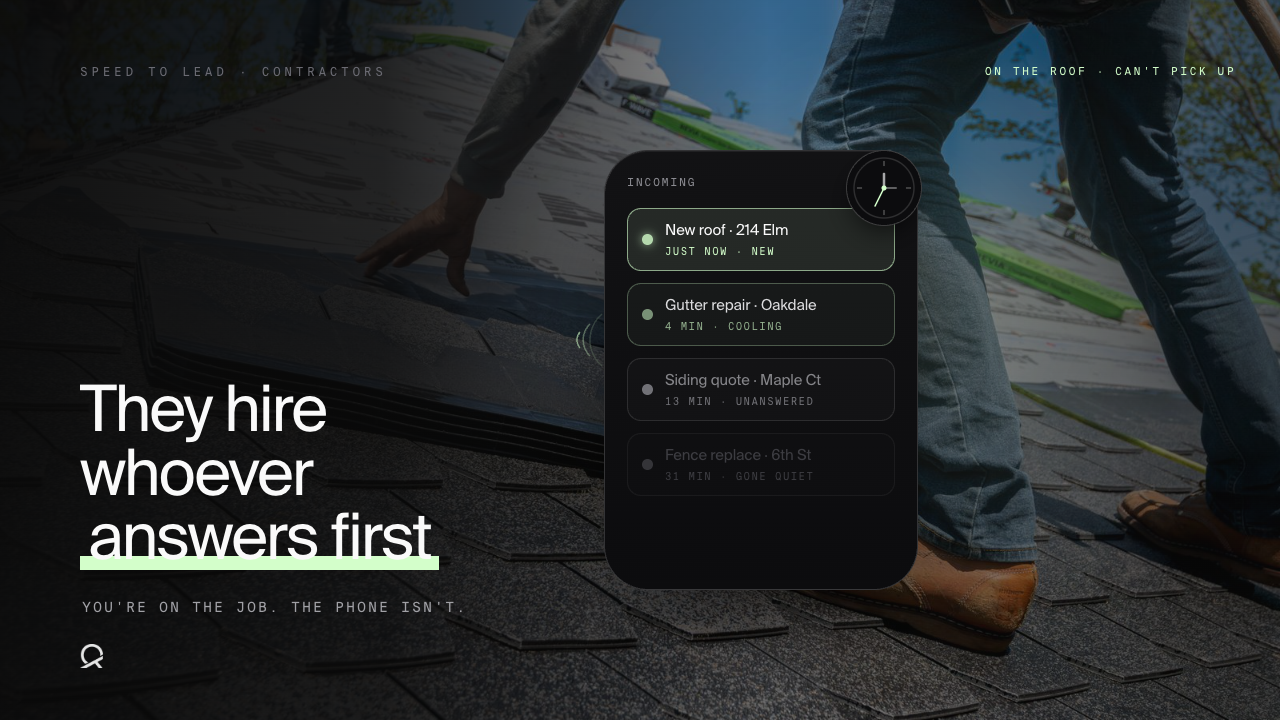
Speed to lead is the time between a customer reaching out and you actually responding, and for contractors it is the single biggest hidden leak in the business. Not your prices. Not your reviews. The gap between a homeowner messaging you and getting an answer, because by the time you reply that evening, someone faster has already booked the job. This piece runs the numbers on your trade specifically, and shows the fix.
The short answer
Home-service customers do not contact one business, they contact four or five at once, and they hire whoever answers first. Most contractors lose here, and it is not laziness. You are on a roof, under a sink, or driving, while inquiries land in the evening and on weekends. Fix the coverage and the math is large, because you are catching jobs you already paid to generate. The catch, speed only gets you into the conversation. What you say when you get there is what wins it.
Saturday morning, from her side
A homeowner sees water staining her ceiling on a Saturday. She pulls up her phone and messages five roofers in about ten minutes. She is not choosing a roofer yet. She is triaging a problem, and she will deal with whoever deals with her first.
Walk the next 48 hours from her side, not yours. One roofer replies in twenty minutes, asks two sensible questions, and offers to come Tuesday. By the time you finish the job you are on and check your phone at 8pm, she has already booked him. You were not slower because you are worse. You were slower because you were working. She never heard your name, and you will never know she existed.
Why contractors struggle here, and it is not discipline
The response numbers in home services are poor. One study of 466 home-service companies found 95 percent did not respond within five minutes, 40 percent never responded at all, and the slowest took more than five days. Treat the precise figures with some caution, because most speed-to-lead benchmarks in this industry are published by companies selling marketing or software to contractors, and that is a real conflict worth naming. The direction is not seriously disputed though, and neither is the cause.
And the cause is structural, not personal. Your work physically prevents you from answering. You cannot text back from a roof, take a call under a sink, or quote a job while driving to the next one. Your inquiries do not arrive during your 40 working hours either, they arrive in the evenings and on weekends, because that is when the homeowner finally sits down to deal with it.
So the problem is coverage, not effort. There are 168 hours in a week and you can personally cover maybe 40 of them well. The other 128 are when a lot of your inquiries land. No amount of hustle fixes a math problem.
What it actually costs, on trades numbers
Here is the arithmetic on a typical contractor. Say 30 inquiries a month at $8,000 gross profit per job. Today you reach about 60 percent of them before they go cold, and you close 25 percent of those conversations. That is 30 x 0.60 x 0.25 = 4.5 jobs a month.
Now cover the hours you are missing, so you reach 72 percent instead of 60, and because you are more often the first real conversation, you close 28 percent instead of 25. That is 30 x 0.72 x 0.28 = about 6 jobs a month. The difference is roughly 1.5 extra jobs a month, which at $8,000 gross profit is around $12,000 a month, or close to $149,000 a year. That is a 12-point lift in reach and a 3-point lift in close, nothing heroic, and it still lands in six figures, because it compounds against demand you already paid for.
Those are illustrative numbers, not a promise. Run them on your own inquiry count and your own gross profit, and be honest about the other direction too. If you get six inquiries a month at $600 a job, this math gives you a few hundred dollars, and a system to capture it eats most of that. That is not a speed problem, it is a demand problem, and your money belongs at the top of the funnel instead.
Speed gets you the conversation, specificity wins it
One more trades-specific truth. Answering first only puts you in the race. What the homeowner actually wants to know is whether you understand her house. A fast reply that shows you get her specific job beats a fast reply that just quotes a figure, which is why showing the finished result beats sending a price. Speed is the ticket in. Specificity closes.
What to do this week
Three steps, in order. First, measure your own response time honestly by sending a test inquiry through your website or Google profile and timing how long until a real reply. Most owners are shocked. Second, route every inquiry, calls, forms, Google messages, texts, into one place so nothing hides in a channel you forget to check. Third, cover the hours you physically cannot, so evenings and weekends get an instant, useful response instead of silence. That last step is where an AI receptionist earns its place, answering and booking while you are on the roof.
Key takeaways
Home-service customers contact several businesses at once and hire whoever answers first.
Most contractors are slow because the work blocks it and inquiries arrive after hours. It is a coverage problem, not a discipline one.
On illustrative numbers (30 inquiries, $8k profit), closing the gap is worth roughly $149,000 a year. Run it on yours.
If you get few low-value inquiries, this is a demand problem, not a speed one. Fix traffic first.
Speed gets you the conversation. Showing you understand the specific job wins it.
FAQ
What is a good speed-to-lead time for contractors?
Faster is always better, and the sharpest drop-off is in the first five minutes. During work hours, aim to acknowledge every inquiry within minutes. After hours, the realistic answer is a system that responds instantly for you, because you cannot.
How do I respond fast when I am on a job all day?
You do not do it by hand, that is the trap. You route all inquiries to one place and use an automated first response to cover the hours you are working or asleep, with the conversation handed to you once it is qualified and booked.
Is speed to lead worth it for a small contractor?
It depends on your numbers. Run the math on your inquiries and job value. With real volume and mid-to-high job value it pays for itself quickly. With very low volume or low job value, spend on getting more inquiries first.
Want the real number for your business? Our free AI audit and Speed to Lead Calculator runs this model on your actual inquiries and job value, and shows exactly how many jobs you are leaking. No pitch, just the math.